
Accreditation through the Council for the Accreditation of Educator Preparation (CAEP) asks programs to do something deceptively demanding: tell a coherent, evidence-based story about the quality of an educator preparation program. The 2022 CAEP standards for initial-level programs are organized around five interconnected expectations, spanning candidate knowledge and skills, clinical partnerships, candidate recruitment and support, program impact, and quality assurance. For programs navigating that framework, the challenge is rarely a lack of effort or intention. It is more often a question of evidence: what data do we have, does it speak to the right standards, and can we build a convincing case with it?
What many programs have not yet considered is how Passage Preparation™’s platform data can contribute directly to that evidence base. As a platform to support candidates preparing for educator licensure assessments, Passage Preparation generates a range of candidate-level and program-level data that, when interpreted thoughtfully, can contribute meaningfully to a program’s CAEP narrative, most directly under Standards 1, 3, and 5.
Understanding Where the Connection Lives
CAEP’s five standards address both candidate outcomes and program infrastructure. Standard 1 focuses on content and pedagogical knowledge, asking programs to demonstrate that candidates develop the disciplinary understanding and instructional competence their credential requires. Standard 3 addresses candidate recruitment, progression, and support, including how programs monitor advancement and ensure candidates demonstrate competency at completion. Standard 5 addresses the quality assurance system itself, requiring programs to maintain a system of multiple measures that produces valid, cumulative, and actionable data and supports sustained continuous improvement.
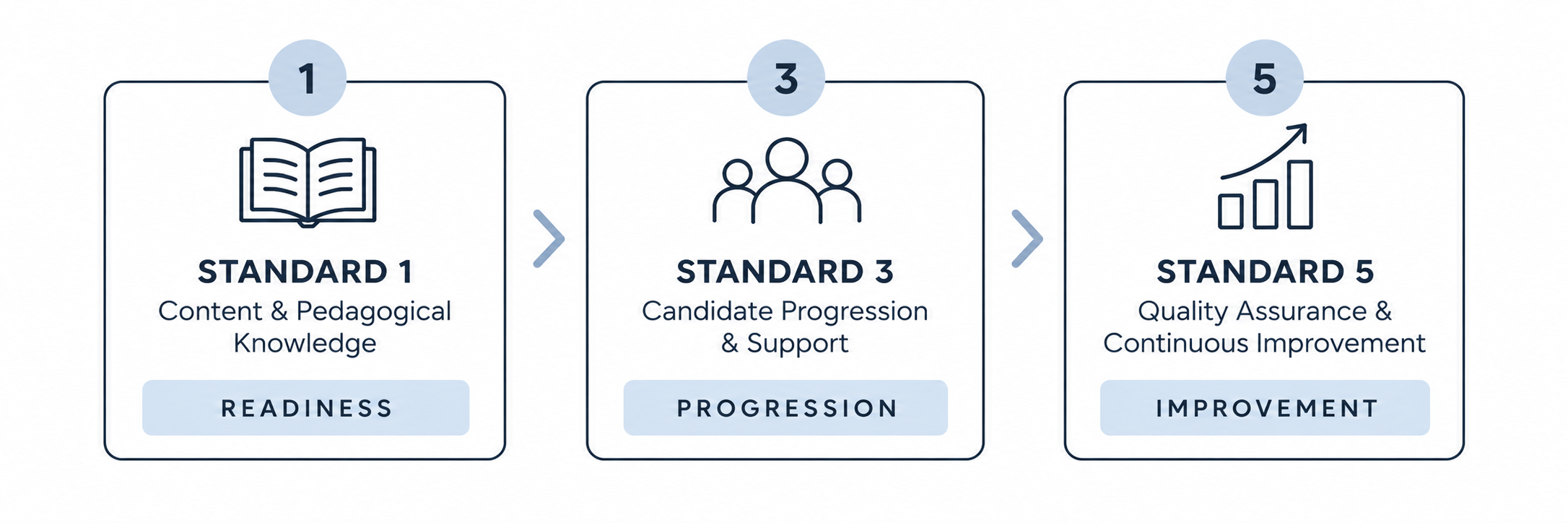
These three standards are where Passage Preparation’s data has the most direct relevance. Standards 2 and 4, which address clinical partnerships and program impact on P-12 student learning respectively, are harder to connect to a test preparation platform, and programs should resist the temptation to overreach. The stronger argument is a focused one.
What Passage Preparation Data Can Tell a Program
The Passage Preparation platform provides programs with access to several categories of data through the Passage Preparation Portal. Each of these data categories has a plausible connection to the CAEP evidence framework.
Diagnostic Assessment Data
Candidates who enroll in Passage Preparation courses begin with a diagnostic assessment designed to identify current levels of content mastery across the domains measured by their licensure exam. At the program level, this data can be aggregated to reveal patterns in candidate readiness, including which content areas candidates enter with confidence and where they may need additional instructional support before sitting for the exam.
For CAEP purposes, this data speaks most directly to Standard 1, which requires programs to demonstrate candidates’ developing content and pedagogical knowledge. Diagnostic data provides a pre-intervention baseline that, when tracked over time, allows programs to document candidate growth rather than simply reporting a single high-stakes outcome. It also speaks to Standard 5, which requires programs to maintain a quality assurance system built from multiple measures. Diagnostic data is exactly the kind of formative, candidate-level measure that can contribute to the assessment system CAEP requires.
Practice Assessment and Progression Data
As candidates move through Passage Preparation courses, they complete practice assessments that simulate the structure, format, and cognitive demands of their licensure exam. Performance data from these assessments, available at both the individual and cohort level, provides a more detailed and longitudinal picture of candidate readiness than a single end-point exam score can offer.
Programs can use this progression data to identify candidates who may be at risk of not passing their licensure exam and to intervene before the assessment window. Under Standard 3, CAEP expects programs to monitor candidate progression and provide evidence of how they support candidates through to successful completion. Documented use of practice assessment data in advising conversations, targeted support referrals, or curriculum review decisions demonstrates exactly that kind of systematic, data-informed monitoring. Under Standard 5, this same data contributes to the multi-measure quality assurance system CAEP requires, providing a running picture of candidate development that complements institutional assessments and clinical evaluations.
Course Completion and Engagement Data
Programs in partnership with Passage Preparation can track which candidates have engaged with the platform, which courses they have accessed, and the extent of their engagement over time. While engagement data is not a direct measure of content mastery, it is a meaningful indicator of program-level support infrastructure. A program that can demonstrate it has deployed targeted test preparation resources, monitored candidate uptake, and followed up with candidates who have not engaged is telling a story about systematic candidate support, precisely the kind of story Standard 3 is designed to honor.
Cohort-Level Pass Rate Context
Passage Preparation does not independently track licensure exam pass rates, as that data resides with state agencies and assessment providers. However, programs can construct a meaningful analytical narrative by triangulating Passage Preparation engagement and assessment data with their own pass rate outcomes. Candidates who completed Passage Preparation courses can be analyzed as a subset of the broader completer cohort, allowing programs to examine whether structured test preparation correlates with improved first-attempt pass rates.
This kind of internal analysis, conducted rigorously and documented transparently, strengthens Standard 1 evidence by demonstrating that the program is actively studying the relationship between its support practices and candidate outcomes. It also strengthens Standard 5 by demonstrating that the program uses data to test and evaluate program elements, one of CAEP’s explicit expectations for a functioning quality assurance system.
External research supports the value of this approach. A 2025 efficacy study conducted in partnership with iteach, one of Texas’s largest alternative certification providers, found a clear and statistically significant relationship between Passage Preparation practice assessment performance and certification exam outcomes. Candidates who met the platform’s preparedness benchmark passed their licensure exams at a rate of 94%, compared with 54% among those who did not. Programs can reference this research as contextual support for their own data-informed decisions about candidate preparation resources.
See Passage Preparation in Action
▶ Explore the Passage Preparation Portal
Connecting to Standard 5: The Quality Assurance Argument
Standard 5 is where Passage Preparation’s contribution to a CAEP narrative may be most significant, and most underappreciated. CAEP requires that programs maintain a quality assurance system built from multiple valid, representative, and cumulative measures. It further requires that programs use this system to establish priorities, test innovations, and improve program elements over time.
Passage Preparation data, embedded within a program’s broader quality assurance infrastructure, contributes to that requirement in several ways. It adds a formative, candidate-level data stream that most programs do not otherwise have in a standardized form. It provides data specifically aligned to the licensure assessments candidates must pass, which are among the most consequential outcomes a program can track. And it generates data at a cadence — diagnostic at entry, practice assessment results throughout preparation, and engagement data across the full course period — that allows programs to monitor trends rather than relying solely on single-point snapshots.
Critically, however, the data itself is not enough. What CAEP reviewers are looking for under Standard 5 is evidence of faculty governance — the documented involvement of assessment committees, program faculty, and leadership teams in reviewing data and making decisions based on what it reveals. This is a point that cannot be overstated. A program that collects Passage Preparation data but reviews it only at the administrative level is telling an incomplete Standard 5 story. A program that brings that data to faculty meetings, assessment committee reviews, and program leadership discussions and that documents the decisions those conversations produce is telling the story CAEP is looking for.
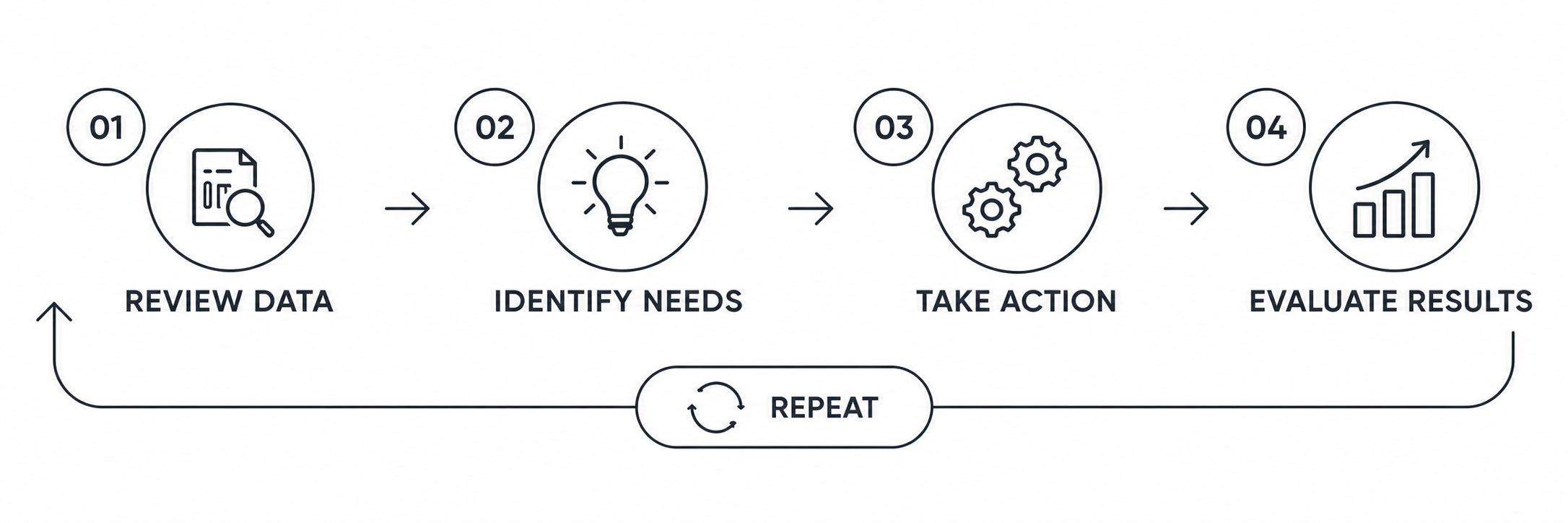
In practice, this might look like faculty reviewing cohort-level diagnostic and practice assessment data each semester to identify content areas where candidates are consistently underprepared. Those findings might prompt a curriculum review, a revision to course sequencing, or a decision to deploy targeted preparation resources — including Passage Preparation’s own Prep+ or synchronous course offerings — for specific candidate populations. The outcomes of those interventions, documented and brought back to faculty the following semester, complete the continuous improvement cycle that Standard 5 is designed to honor. At each step, the involvement of faculty in reviewing evidence, deliberating about its implications, and making collective decisions about program practice is what transforms data into a quality assurance argument.
Programs that can show CAEP reviewers not just that they have this data, but that it flows through a faculty-governed review process that produces documented programmatic decisions, are making the strongest possible Standard 5 argument. The question CAEP asks is not whether data exists, but whether the program has created a culture of evidence in which faculty are active participants in interpreting data and using it to drive improvement. Passage Preparation can help a program build and sustain that culture.
Framing the Evidence Appropriately
As with any accreditation process, the way evidence is framed matters as much as the evidence itself. A few principles are worth keeping in mind.
First, correlation is not causation. Programs should not claim that Passage Preparation caused improved licensure pass rates unless they have a research design capable of supporting that claim. What programs can claim, accurately and defensibly, is that they identified a need, deployed a structured resource, monitored engagement and performance, and observed outcomes consistent with their goals. That is a quality assurance argument, not a causal one, and it is appropriate for an accreditation context.
Second, Passage Preparation data is most powerful when embedded in a continuous improvement narrative. CAEP reviewers are not looking for favorable data points in isolation. They are looking for evidence that a program collects data systematically, interprets it thoughtfully, and uses it to make decisions. Programs that can show a cycle of inquiry — a gap identified, a resource deployed, engagement monitored, and lessons applied to future cohorts — are telling the kind of story CAEP’s Standard 5 is specifically designed to honor.
Third, candidate-level data should be used in aggregate for accreditation reporting purposes, consistent with the program’s data governance and privacy policies. Cohort-level analysis is generally the appropriate unit of analysis, rather than the identification of individual candidates by outcome.
The Broader Point
CAEP accreditation asks programs to demonstrate not just that they prepare good teachers, but that they know how they prepare good teachers, and that they use that knowledge to get better over time. Passage Preparation is not a substitute for that work. What it offers is a structured, standards-aligned source of candidate data that, when integrated thoughtfully into a program’s quality assurance infrastructure, can deepen the evidence base a program brings to its CAEP self-study and review.
Programs already using Passage Preparation to support their candidates are generating data that brings value to the accreditation process. The opportunity is to use that data intentionally, connect it to the right standards, and build it into the continuous improvement story that CAEP expects every accredited program to tell.
For more information about how Passage Preparation supports educator preparation programs, or to discuss how your program might leverage platform data in its quality assurance work, contact me at nathan.estel@passagepreparation.com.
Share This Story, Choose Your Platform!
About the Author: Nathan Estel